 CN
CN
CN
CN
CN
CN
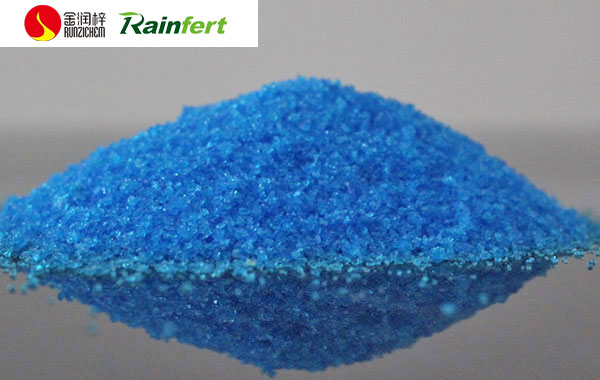
Copper sulfate appears as sky-blue or slightly yellowish granular crystals. Its aqueous solution is acidic. It is a protective inorganic fungicide, relatively safe for humans and livestock. Its chemical formula is CuSO₄. It usually exists as pentahydrate CuSO₄·5H₂O, commonly known as blue vitriol; it is a blue rhombic crystal with a density of 2.284 g/cm³. Copper sulfate is an important raw material for preparing other copper compounds. Mixed with milk of lime, it can form "Bordeaux mixture" used as an insecticide. Copper sulfate is also used as an electrolyte in the electrolytic refining of copper.
Functions and Applications of Copper Sulfate
(1) In inorganic industry, it is used to manufacture other copper salts such as cuprous chloride, cupric chloride, copper pyrophosphate, cuprous oxide, copper acetate, copper carbonate, etc.
(2) In dye and pigment industry, it is used to produce copper-containing monoazo dyes such as reactive brilliant blue, reactive violet, etc.
(3) In organic industry, it serves as a catalyst for synthesizing intermediates of perfumes and dyes, and a polymerization inhibitor for methyl methacrylate.
(4) In coating industry, it is used as a fungicide for manufacturing antifouling paints for ship bottoms. In electroplating industry, it is used as the main salt and copper ion additive for bright acid copper plating.
(5) In printing and dyeing industry, it is used as a mordant and oxygen assistant for fine dyeing of fabrics.
(6) Used as a fungicide in agriculture.
(7) In aquaculture, it is used as the main raw material of trace element copper for feed additives.
(8) Food-grade copper sulfate can be used as a chelating agent and clarifier in the production of preserved eggs and wine.
(9) In biology, it is used to prepare Fehling's reagent for detecting reducing sugars and Solution B of Biuret reagent for identifying proteins, which are usually prepared freshly before use.
(10) For the preparation of Bordeaux mixture.